Generate the data
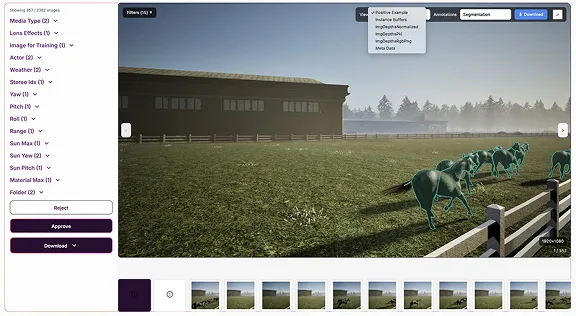
Control every parameter: lighting, weather, camera angle, actors, occlusion. Generate unlimited variations.
- ›Parametric scene controls
- ›Unlimited scenario variations
- ›No data-collection slog
What would you build if the sim-to-real gap disappeared? Any object, any condition, any edge case: rendered with perfect annotation, at a scale the real world can't reach.
We render training data instead of collecting it. Physics-accurate, pixel-perfect ground truth, infinite variation. Every edge case, every lighting condition, every angle, generated a thousand ways before it ever shows up in the field. The scenario you've never seen is already in your training set.
Full body at 50 meters. Hands and face up close. Micro-expressions when you need them. One model, every level of detail. No retraining, no swap.
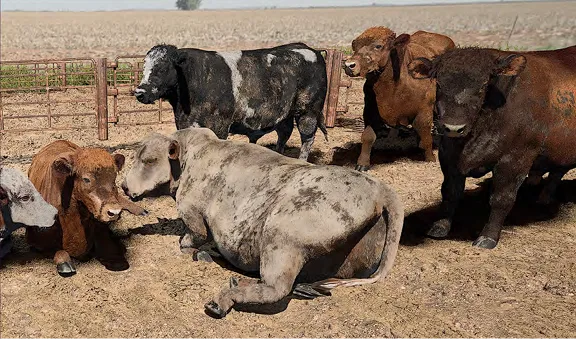
Gait changes. Posture drift. Eating patterns. Per-animal, every animal, all the time.
You know who ate. Who didn't. Who's limping. Who's pregnant. Who's worth $4,000 and who's worth $400.
No six-month data-collection slog. No army of annotators. No edge-case roulette six months after launch.
Rendering today. Shipping to clients now.
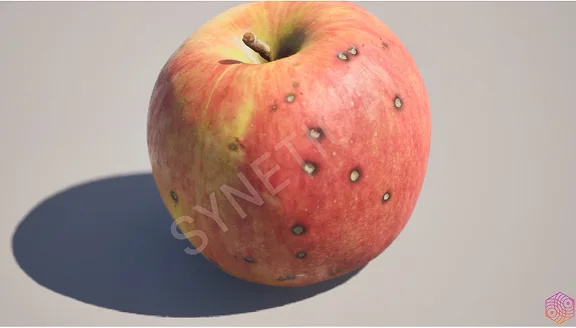
Not a labeling vendor. Not a model shop. The data layer underneath all of it. Hundreds of millions of physics-accurate images, pixel-perfect annotations, any object, any condition. Created on demand, not scraped and crowd-labeled.

Control every parameter: lighting, weather, camera angle, actors, occlusion. Generate unlimited variations.

Every image ships with pixel-perfect ground truth. Because we placed every pixel, we know what every pixel is.

Physics-based rendering produces images statistically indistinguishable from real. No domain gap to overcome.

Train on the data, or let us build the model. Either way it runs on your cameras, your edge devices, your floor.

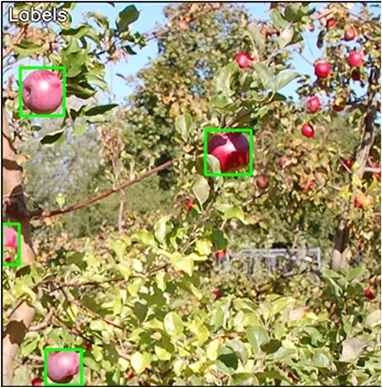
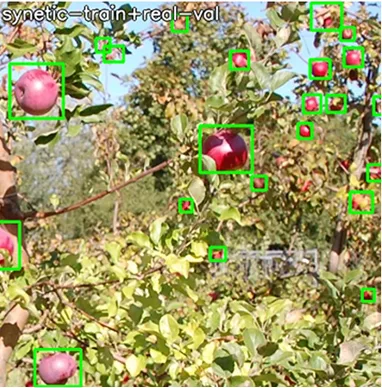
Human labels miss several apples.

Misses apples, limited detection.

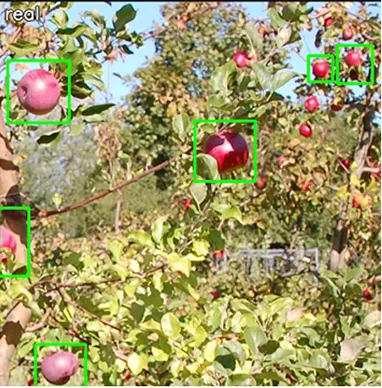
Detects every apple, including the ones humans missed.
The Synetic-trained model (right) detected apples missed in the human-labeled "ground truth" (left). What looks like false positives are actually correct detections.
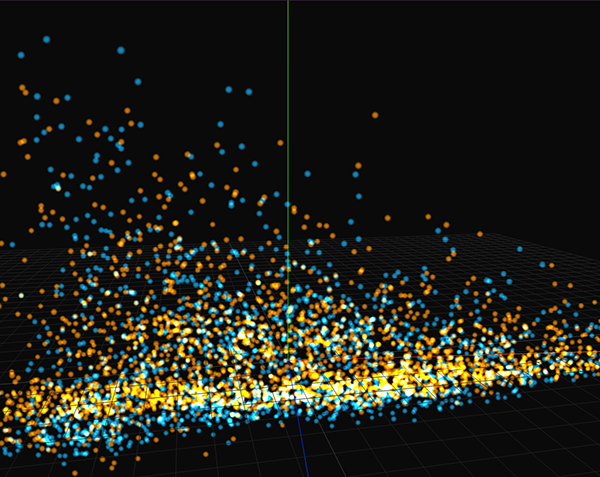
Real-trained detections (blue) versus Synetic-trained (orange) in embedding space. Drag the threshold and watch which model clusters tighter to human ground truth.
Left-drag to rotate · scroll to zoom · drag the slider to filter by distance to ground truth.
| Model | Real-only mAP | Synetic mAP | Improvement |
|---|---|---|---|
| YOLOv12 | 0.240 | 0.322 | +34.24% |
| YOLOv11 | 0.260 | 0.344 | +32.09% |
| YOLOv8 | 0.243 | 0.290 | +19.37% |
| YOLOv5 | 0.261 | 0.313 | +20.02% |
| RT-DETR | 0.450 | 0.455 | +1.20% |
Seven architectures tested. All improved on a real-world validation set. Full methodology peer-reviewed by USC researchers.
"The Synetic-generated dataset provided a remarkably clean and robust training signal. Our analysis confirmed the superior feature diversity of the synthetic data."
"We trained a model on 99% synthetic data that successfully deployed on our field robots, identifying weeds and triggering treatment without damaging a single crop plant. The data quality was solid enough that we went straight from synthetic training to real-world deployment with minimal friction."
Catch defects before they leave the line: solder bridges, misalignment, surface flaws.
Crop detection, yield estimation, plant counting at scale, on real field cameras.
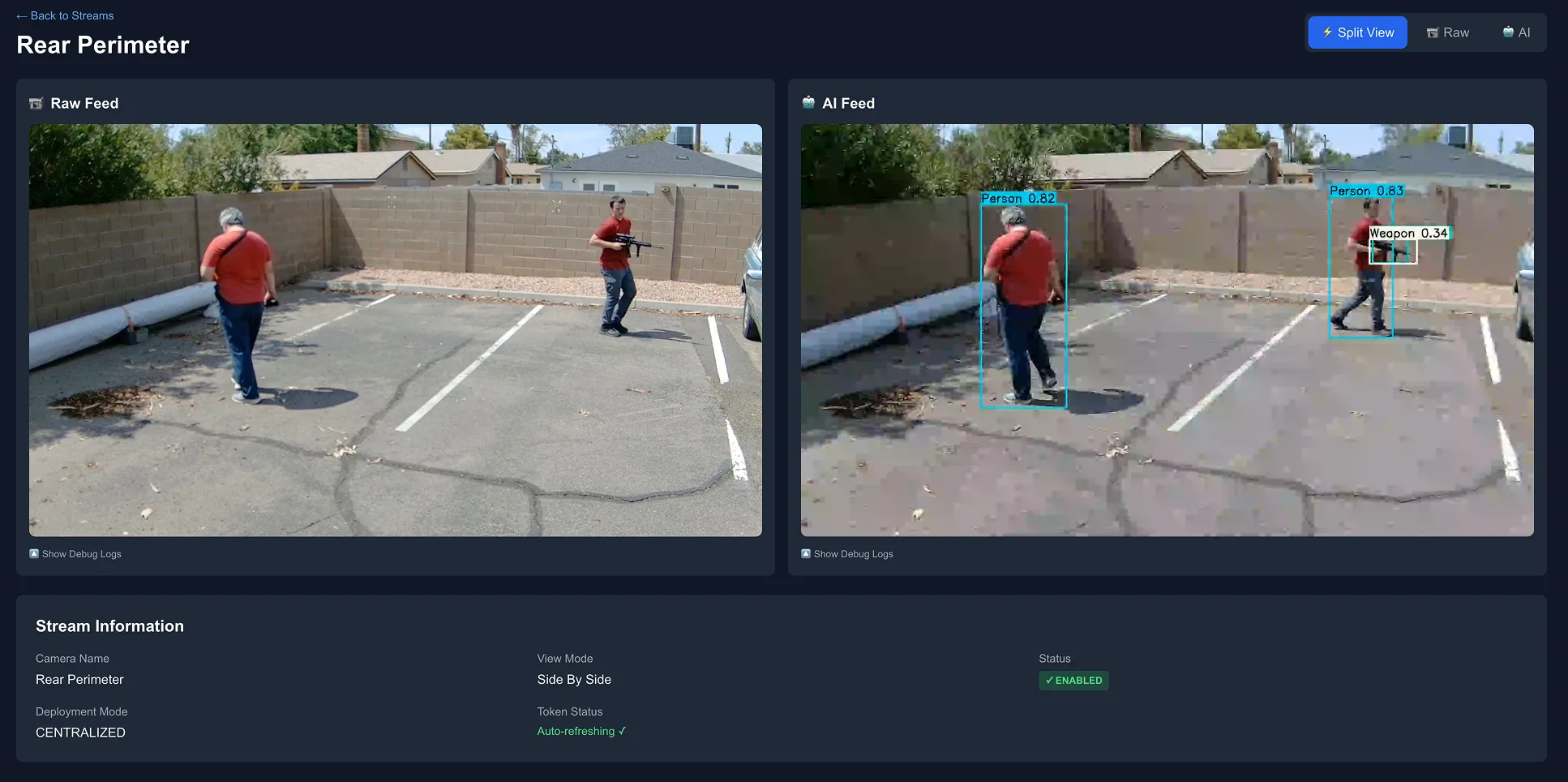
Identify threats and anomalies in real time across perimeters and facilities.
Train perception models entirely in simulation: grasp, navigate, manipulate.
Track inventory, customer journeys, and behavior without facial recognition.
Monitor safety, packages, trailers, and yard movements end to end.
The CV SDK we built entirely on Synetic data. A 2.4 MB model that matches a 32M-parameter transformer, without a single real training image. We built it to settle the argument.
Visit golynx.ai →Some problems are too specific for off-the-shelf. Your SKUs, your factory, your one-of-a-kind rig. Bring the problem. We create every edge case, every angle, every condition. You ship the model.
Tell us what you're building →Real-world datasets are limited by what you can photograph and afford to label. Ours cover edge cases systematically, with perfect labels. The USC white paper proves it: +34% across multiple architectures, measured on a real-world validation set.
Yes. Physics-based rendering keeps synthetic and real data statistically similar, so there's no domain gap. The 34% improvement was measured on real-world validation data, not synthetic tests.
That's exactly what we're built for. Tell us what you need and we create the training data for it. We've built hundreds of models across dozens of industries. If you can describe it, we can create it.
No. We create everything synthetically. You can add real data later if you want, but it isn't required, and the research shows it can actually hurt performance.
Omniverse is a rendering and simulation engine you operate yourself: you build the scenes, run the pipeline, produce the data. Synetic is a data source: you tell us what you need and we deliver finished, annotated training sets. Different layer of the stack. In fact, our work runs on NVIDIA hardware, and DeepStream integration is on our roadmap.
We'll tell you straight whether synthetic data solves it. No pitch, no junior account rep. A real conversation with someone who's built this.